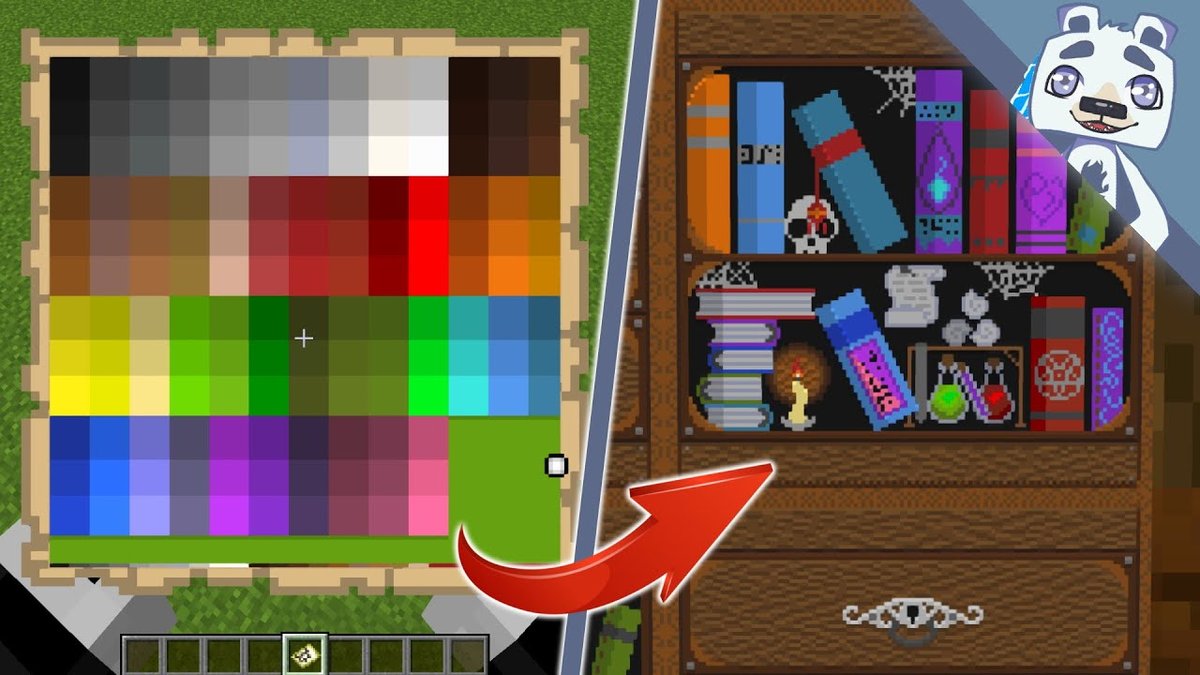
Ever wondered how those incredible, giant artworks appear on maps in Minecraft, transforming your humble dwelling into a gallery? It's not magic, but rather a fascinating dance with the game's underlying systems. Mastering Understanding Minecraft Map Art Mechanics unlocks a whole new dimension of creativity, turning simple block placement into breathtaking pixel murals visible from afar. This guide cuts through the complexity, showing you exactly how to manifest your artistic vision within the blocky world.
At a Glance: Crafting Map Art in Minecraft
- The Map's Canvas: A single Minecraft map displays an 8x8 chunk area, not an arbitrary square.
- Chunk Awareness is Key: Each chunk is a 16x16 block square. Understanding their boundaries is fundamental.
- Java Edition's Helper: Use
F3 + Gto visualize chunk borders and locate your map's precise edges. - Pixel Density: For a level 3/4 map, one map "pixel" corresponds to an 8x8 block section on the ground.
- Cost-Effective Design: You don't need to fill every block. Placing a single block (like carpet) every 8th block within an 8x8 section defines one map pixel, dramatically cutting material costs.
- Adding Detail: Raised layers of blocks create different shading and colors on the map, allowing for greater artistic depth than flat designs.
- Purpose: Map art is fantastic for customizing bases, creating server landmarks, or simply expressing your creativity on a grand scale.
The Canvas Unveiled: Decoding Map Art's Core
Minecraft map art isn't about meticulously building a giant image block-by-block and hoping for the best. It's about strategically placing blocks within a defined grid so that a map item, when held or displayed, renders your creation as a two-dimensional image. Think of it as painting on a colossal canvas, where the brushstrokes are blocks and the canvas itself is sectioned by the game's terrain generation: chunks.
This interplay between player-placed blocks and the game's rendering system is what makes map art both challenging and incredibly rewarding. It allows you to transform mundane landscapes into stunning visuals, visible from anywhere a copy of the map is viewed.
Navigating the Grid: Mastering Minecraft's Chunk System
At the heart of map art lies the chunk system. Without understanding how chunks work, your map art will inevitably be misaligned, fragmented, or simply not appear as intended.
What's a Chunk, Anyway?
In Minecraft, the world isn't an endless, amorphous expanse. It's divided into discrete sections called "chunks." Each chunk is a 16-block by 16-block square, stretching from bedrock (Y=0) to the build limit (Y=320 in modern Java Edition). The game loads and unloads chunks as players move around, which is why you sometimes see the world "pop in" as you explore.
For map art, this 16x16 block dimension is your foundational unit.
Maps and Their Domains: The 8x8 Chunk Area
Here's the critical piece of information: a single Minecraft map item doesn't just show any random area. It specifically displays an 8x8 chunk area. That's a massive 128x128 block square (8 chunks * 16 blocks/chunk = 128 blocks).
Crucially, maps are tied to your current location when you create or update them, not some fixed point in the world. This means you need to manually determine where your 8x8 chunk canvas begins and ends. Get this wrong, and your art will be cut off, or you'll be drawing on the wrong map section entirely.
F3 + G: Your Best Friend for Chunk Management (Java Edition)
For Java Edition players, a simple key combination transforms the challenge of chunk alignment into a manageable task:
- Press
F3: This brings up the debug screen, overlaying a wealth of information on your display. - Press
G(whileF3is held): This toggles the visibility of chunk borders. You'll see green grid lines appear, delineating each 16x16 block chunk.
With these grid lines visible, you can easily identify the exact boundaries of your map's 8x8 chunk area.
Pinpointing Your Map Art's Edges
Once you have the chunk borders visible, here’s how to set up your canvas:
- Find a starting point: Choose a chunk that will serve as the bottom-left (or any corner) of your 8x8 map area.
- Mark the corners: Walk to the exact corners of this 8x8 chunk square. Each corner will be at the intersection of four chunk borders. Place a distinctive block (like a beacon, obsidian, or a specific wool color) at each of the four corners to mark your map art's outer boundaries. This 128x128 block square is now your art canvas.
- Confirm Alignment: Create a blank map while standing within this area. Then, walk to the very edges you've marked. If your markers disappear from the map view when you cross a certain line, you've found an edge.
This methodical approach ensures your map art is perfectly contained within the map's display area, preventing frustrating cut-offs.
Building Your Vision: Design Principles for Map Art
With your canvas defined, it's time to consider how your chosen blocks translate into map pixels. This is where the true mechanics of map art come into play.
The "Pixel" Problem: Block-to-Map Resolution
One of the biggest misconceptions new map artists have is thinking that one placed block equals one map pixel. This isn't true, especially for larger maps.
For a standard level 3/4 map, which is the most common for detailed artwork, each "pixel" on the map actually represents an 8x8 block section on the ground. That means a single map pixel is a whopping 64 blocks in area!
This resolution is crucial because it informs how you place your blocks for visual effect. If you're designing something that needs fine detail, you're working with 8x8 block squares as your smallest unit of color.
Raising the Bar (Literally): Leveraging Verticality for Detail
One of the most powerful map art techniques involves using different vertical layers to create unique colors and shading. How does this work?
Maps render blocks based on their top-most surface. However, the game also applies a slight shading effect based on whether a block is considered "higher" or "lower" relative to its surroundings, or if it's explicitly casting a shadow.
- Elevated Blocks: By building a block one level higher, you can often achieve a subtly different shade of the same block on the map. For example, placing a patch of grass blocks at Y=64 will look one shade, while placing identical grass blocks at Y=65 will appear slightly different.
- Shadow Casting: Blocks that are entirely covered by other blocks (like the underside of a platform) will appear darker.
- Material Variety: Different block types naturally have distinct colors, but their "map color" can also be influenced by height. Experiment with blocks like concrete, wool, terracotta, and even natural blocks like dirt, stone, and sand. Each offers a unique hue on the map.
This technique is essential for adding depth, contrast, and visual interest, making your art pop far more than a simple flat design.
Flatland Creations: Simple, Yet Effective
While raised layers offer superior detail, flat surface designs are also perfectly viable, especially for simpler logos, text, or less intricate patterns. In a flat design, you're laying down blocks at a consistent Y-level across your 128x128 block canvas.
The trade-off is often less color variation and shading depth. You're relying purely on the base map color of each block type. This can still be stunning, particularly for vibrant, high-contrast designs, but it limits the subtle nuances achievable with verticality.
The Art of Efficiency: Cost-Effective Map Art Techniques
Building map art can be incredibly resource-intensive, especially for large, detailed pieces. Filling a 128x128 block area entirely with certain materials can quickly deplete your storage. Thankfully, there’s a clever trick to significantly reduce material costs.
The Single Block Pixel: Saving on Materials
Remember that an 8x8 block section on the ground represents one map pixel for a level 3/4 map. Here's the brilliant part: you don't need to fill that entire 8x8 section with blocks of the same color to achieve that map pixel's color.
Instead, you can place a single block, such as a carpet, wool block, or concrete block, on every 8th block within that 8x8 section. This means for each 8x8 pixel area, you might only need one or two visible blocks to register its color on the map.
Consider an 8x8 block square. If you place a red carpet in the exact center, or even just one corner, and the surrounding 63 blocks are empty or of a different "background" material (like grass or dirt), the map will still interpret that 8x8 area as primarily red.
This technique dramatically reduces the material cost, making large-scale map art projects comparable in expense to even smaller, level 0/4 maps. It's incredibly adaptable and works for various map sizes and scales, as long as you understand the underlying block-to-pixel ratio. This efficiency is a game-changer, allowing more players to create ambitious artworks without the monumental grind.
From Idea to Icon: A Step-by-Step Workflow
Creating map art is a project, and like any good project, it benefits from a structured approach.
Phase 1: Planning and Preparation
Before you even touch a block in Minecraft, a little planning goes a long way.
- Conceptualize Your Design: What do you want to create? Many artists start by designing their pixel art in a dedicated program or even just sketching it out on graph paper. Think about color palettes and how they'll translate using Minecraft blocks. Consider using a Minecraft map art generator to help visualize and plan your design, especially for complex images.
- Choose Your Map Level:
- Level 0/4 (1:1 scale): 1 block = 1 pixel. Covers 128x128 blocks. This is for extreme detail but limits the total map area significantly.
- Level 1/4 (1:2 scale): 2 blocks = 1 pixel. Covers 256x256 blocks. Good balance.
- Level 2/4 (1:4 scale): 4 blocks = 1 pixel. Covers 512x512 blocks. Less detail per block, but larger area.
- Level 3/4 (1:8 scale): 8 blocks = 1 pixel. Covers 1024x1024 blocks. This is the most common for large, visible art pieces and what we've primarily discussed.
- Level 4/4 (1:16 scale): 16 blocks = 1 pixel. Covers 2048x2048 blocks. Lowest detail, largest area.
Your chosen map level directly impacts the block-to-pixel ratio and thus the amount of detail you can achieve.
- Gather Resources: Identify the block types you'll need based on your design and map level. Start collecting them. If you're using the cost-effective "single block pixel" method, remember you'll need significantly less of your primary art materials but perhaps more for a neutral background.
Phase 2: Setting Up Your Map Canvas
This is where your chunk management skills come into play.
- Locate Chunk Boundaries: As discussed, press
F3 + Gin Java Edition. If playing Bedrock, you'll need to use external tools or trial-and-error to find your 16x16 block divisions. - Mark Your 8x8 Chunk Area: Carefully define the 128x128 block area that will become your map. Mark the four corners with distinct blocks. For clarity, you might even outline the entire perimeter.
- Clear the Area (Optional but Recommended): For best results, especially with raised designs or if you want precise background control, consider flattening and clearing the entire 128x128 block area within your marked boundaries. This removes any existing terrain that might interfere with your colors or cause unwanted shadows.
Phase 3: Pixel by Pixel Construction
Now, the actual building begins!
- Implement Your Design: Translate your planned pixel art onto the ground, working within your 128x128 canvas. If using the 1:8 scale (level 3/4 map), remember each 8x8 block square on the ground corresponds to one map pixel.
- Apply Techniques:
- Flat Design: Lay down your chosen blocks at a consistent Y-level.
- Raised Layers: Introduce variations in Y-level to create shading and distinct colors as needed for your design.
- Cost-Effective: For level 3/4 maps, place only a single block (like carpet) every 8th block within an 8x8 area to represent one pixel.
- Double-Check and Iterate: Frequently take a step back and compare your progress to your design. Create a blank map (right-click with an empty map item) while standing within your map art area to see how it's rendering. Don't be afraid to adjust blocks if the colors aren't appearing as expected.
Phase 4: Mapping and Display
The final steps bring your masterpiece to life.
- Create/Update the Map: Once your artwork is complete, stand anywhere within the 128x128 block area and right-click with an empty map item to create a new map, or with an existing map to update it.
- Make Copies: If you want to display your art in multiple locations or share it, place the finished map in a cartography table with empty map items to create copies.
- Display Your Masterpiece: Place your map into an item frame. You can display individual maps or create giant murals by arranging multiple maps side-by-side in item frames, each showing a different section of a much larger artwork.
Advanced Tips and Common Pitfalls
Even with the mechanics down, some subtleties can make or break your map art.
Lighting and Shading: A Subtle Influence
Map colors are generally determined by the block type. However, ambient light levels and shadows can subtly influence how blocks appear on the map. Blocks in deep shadow might appear slightly darker. For consistent color, build your art in an area with uniform lighting, or account for potential shadow effects in your design. Avoiding large structures directly above your map art can prevent unwanted shadows.
Biome Influence: The World's Palette
Different biomes can have a very slight, almost imperceptible tint on certain blocks, especially natural ones like grass and leaves. While usually minor, for highly color-sensitive designs, choosing a single biome for your art canvas ensures maximum color consistency.
Dynamic Map Updates: When Your Art Refreshes
Maps don't constantly update in real-time. When you make changes to your map art, you'll need to "refresh" the map. This is done by holding the map in your hand and right-clicking again while standing in the area the map covers. Note that maps held by other players or in item frames will only update if those players also refresh their maps or if the chunk containing the item frame is loaded and the map is physically updated.
Pitfall: Misaligning Chunks
The single biggest mistake in map art is misaligning your build with the map's 8x8 chunk grid. This results in your art being cut off, shifted, or appearing on the wrong map altogether. Always start by clearly marking your chunk boundaries.
Pitfall: Underestimating Material Costs
Even with the cost-effective single-block pixel method, large map art requires significant resources. Plan your materials carefully, especially if using rare blocks. Consider setting up automatic farms for common materials like wool, terracotta, or concrete.
Frequently Asked Questions About Map Art
You've got questions, we've got answers.
Can I do map art in Bedrock Edition?
Yes, map art is possible in Bedrock Edition! The core mechanics (chunks, block-to-pixel ratio) are similar. However, Bedrock Edition does not have the F3 + G debug screen feature to display chunk borders. Players often rely on third-party tools, specific world seeds that reveal patterns, or a methodical trial-and-error approach to locate chunk boundaries.
How do different blocks look on a map?
Each block in Minecraft has a specific "map color" assigned to it. Concrete, wool, and terracotta blocks offer the most vibrant and varied palettes. Natural blocks like dirt, stone, sand, and various wood types also have unique map colors. The best way to know for sure is to create a "swatch test" — place a large patch of different blocks and then view them on a map. This is invaluable for color matching your designs.
How do I update my map if I change the art?
Simply hold the map in your hand and right-click while standing within the area the map covers. This will refresh the map to reflect any changes you've made to the blocks on the ground.
What's the best map level for detail?
For the highest detail, a Level 0/4 map (1:1 scale, 1 block = 1 pixel) is technically superior. However, it only covers a small 128x128 block area. For balanced detail over a larger area, a Level 3/4 map (1:8 scale) is generally preferred by map artists, offering a good compromise between canvas size (1024x1024 blocks) and manageable detail.
Elevate Your Base: Displaying Your Masterpiece
Once your map art is complete and mapped, the final step is to proudly display it. Item frames are your best friend here.
- Single Statement Piece: A single large map in an item frame can act as a striking focal point in a room, a unique sign for a shop, or a custom banner for your faction.
- Grand Murals: The real magic happens when you combine multiple maps. By creating different map art sections that align perfectly, you can arrange them in a grid of item frames to form a truly enormous mural that spans walls, floors, or even ceilings. Imagine an entire wall depicting a custom landscape, a colossal character, or an intricate pattern – the possibilities are endless.
Map art isn't just about the creation; it's about how it transforms your in-game environment, adding a personal, artistic flair that's visible for all to admire.
Beyond the Blocks: Your Next Steps in Map Art
You now have a solid foundation for Understanding Minecraft Map Art Mechanics. From navigating the invisible chunk grid to efficiently placing "pixels" and leveraging verticality for detail, you're equipped with the knowledge to start creating.
Don't be afraid to experiment. The most breathtaking map art often comes from pushing the boundaries of what you think is possible. Try different block combinations, explore various map levels, and challenge yourself with complex designs. The Minecraft community is full of resources and fellow artists eager to share tips and inspiration. Dive in, get building, and watch your world transform into a gallery of your own making.